Blog
What is Indemnity Insurance? Understanding Risk & Policy Ethics
In the world of commerce, finance, and legal liabilities, managing risk is the difference between sustainable growth and sudden bankruptcy. For corporate entities, licensed professionals, and SME owners in Bangladesh, operational threats do not just come from natural disasters or physical property damage—they often stem from human error, contractual breaches, legal disputes, and negligence claims.
This is where Indemnity Insurance becomes essential.
Built on foundational legal statutes and ethical codes, indemnity insurance acts as a shield for your balance sheet. This comprehensive guide breaks down the core mechanics of indemnity, the precise policies operating in the Bangladeshi market, and the strict framework governing insurance ethics under local regulations.
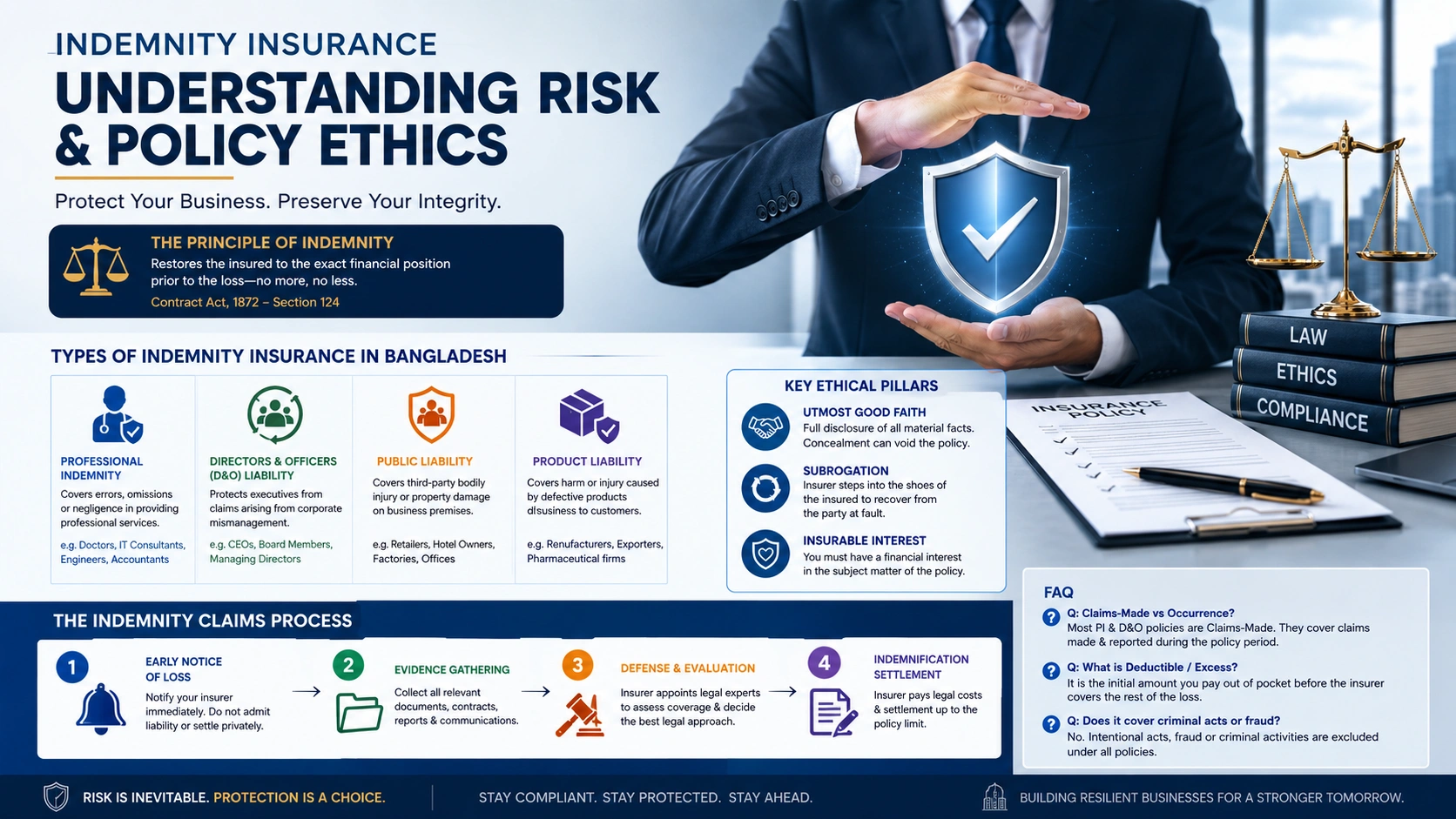
1. The Legal Concept: What is the Principle of Indemnity?
At its legal core, an indemnity contract is designed to restore the insured party to the exact financial position they occupied immediately prior to the loss—no more, no less.
In Bangladesh, this concept is legally rooted in Section 124 of The Contract Act, 1872, which explicitly defines a contract of indemnity as:
"A contract by which one party promises to save the other from loss caused to him by the conduct of the promisor himself, or by the conduct of any other person."
The "No-Profit" Rule of General Insurance
Unlike life insurance policies (which are "valued contracts" that pay a fixed lump sum upon maturity or death), general indemnity insurance is strictly bound by the Principle of Indemnity. This means insurance can never be used as a source of profit or financial windfall. If your business suffers a validated asset or liability loss worth BDT 5,00,000, your maximum insurance payout will be capped precisely at BDT 5,00,000, regardless of whether your overall policy limit is higher.
2. Types of Indemnity Insurance Policies in Bangladesh
The non-life insurance sector, governed by the Insurance Development and Regulatory Authority (IDRA) under the Insurance Act 2010, features several specialized indemnity products tailored to specific professional and corporate risk surfaces:
A. Professional Indemnity (PI) / Professional Liability Insurance
Errors happen, even to highly trained specialists. If a client suffers a massive financial loss due to your flawed professional advice, design defects, or administrative errors, they can file a lawsuit against you. Professional Indemnity insurance covers both the costly legal defense fees and the final court-ordered settlement or judgment damages.
- Medical Malpractice Indemnity: Critical protection for doctors, surgeons, and private diagnostic clinics against allegations of clinical negligence or surgical errors.
- Professional Indemnity for Tech & SEO Agencies: Protects digital consultancies if a mismanaged system migration or algorithm optimization causes a client's e-commerce platform to crash, resulting in lost digital revenue.
- Legal & Financial Architects: Essential coverage for chartered accountants, legal firms, and corporate engineers whose architectural blueprints or audit validations are relied upon for large-scale infrastructure investments.
B. Directors and Officers (D&O) Liability Insurance
Corporate governance carries immense legal exposure. A company's directors and management executives can be held personally liable for decisions that result in financial damages to shareholders, regulatory bodies, or employees.
- What it Covers: Claims arising from mismanagement of corporate funds, breaches of fiduciary duty, regulatory non-compliance, or misleading financial statements. D&O insurance ensures that the personal assets of the executive are insulated from corporate litigation.
C. Public Liability Insurance
Designed for businesses that operate physical facilities where clients, vendors, or members of the general public visit daily (such as retail outlets, corporate towers, manufacturing warehouses, or private banks).
- What it Covers: Third-party bodily injuries or property damage occurring within your business perimeter (e.g., a customer slipping on a wet floor or heavy factory inventory collapsing on a visiting supplier).
D. Product Liability Insurance
For manufacturers, exporters, and distributors—particularly within Bangladesh's dominant Ready-Made Garments (RMG), pharmaceutical, and processed food sectors.
- What it Covers: Financial compensation and legal defense costs if a manufactured item distributed to local or international markets causes illness, severe injury, or property damage due to a production defect, chemical contamination, or insufficient warning labels.
3. Product Comparison: Mapping the Protection Matrix
| Policy Category | Core Risk Protected | Who Must Have It? | Example Claim Event |
|---|---|---|---|
| Professional Indemnity | Erroneous advice, professional negligence, or omission. | Doctors, IT Consultants, Accountants, Engineers. | An engineer miscalculates structural loading, causing a warehouse ceiling to fracture. |
| D&O Liability | Executive decisions leading to corporate financial damage. | Board Members, CEOs, Managing Directors. | Shareholders sue executive management over unauthorized regulatory decisions. |
| Public Liability | Third-party bodily injury/property damage on company premises. | Retailers, Hotel Owners, Heavy Factory Outlets. | A visiting vendor fractures a limb due to an unmarked construction hazard in an office lobby. |
| Product Liability | Harm or illness caused to consumers by a distributed product. | Manufacturers, Exporters, Pharmaceutical firms. | A batch of exported garments contains unlisted dye irritants, triggering a mass recall. |
4. The Policy Ethics: Legal Pillars of General Insurance
Because indemnity contracts involve massive financial payouts, they rely heavily on absolute transparency, mutual honesty, and ethical compliance. If any party violates these standard pillars, the entire policy becomes legally void.
I. Principle of Utmost Good Faith (Uberrimae Fidei)
Under general contract law, commercial transactions often follow Caveat Emptor (let the buyer beware). However, insurance operates on Utmost Good Faith. Both the business owner and the insurance company must reveal all material facts honestly.
- The Risk of Concealment: If an IT agency or clinic deliberately conceals a pre-existing dispute or system vulnerability when completing their proposal form, the insurer reserves the legal right to void the policy retroactively and completely deny any subsequent claims.
II. Principle of Subrogation
Subrogation functions as a direct extension of the indemnity principle. It states that once an insurer pays out a full claim to the insured party, the insurer automatically inherits the legal rights to sue or pursue the third party who originally caused the damage.
- Why it Matters: This prevents the business owner from collecting money twice—once from the insurance provider and a second time via a private legal settlement from the party at fault.
III. Insurable Interest
To legally purchase an indemnity policy, you must have a clear Insurable Interest in the subject matter. This means you must benefit from its preservation or suffer a direct financial loss from its damage or legal liability. You cannot legally buy an indemnity policy for a competitor's office building or independent professional operations.
5. Navigating the Indemnity Claims Process
When a third-party claim or liability notification arrives, moving systematically through these steps preserves your coverage rights:
1. Early Notice of Loss: Immediate Action Required.
As soon as your company receives a formal legal notice, client demand letter, or becomes aware of a serious operational error, notify your insurer immediately. Never admit liability or promise private settlements without your insurer's consent.
2. Evidence Gathering: Building the Case.
Compile all operational paperwork: signed service level agreements (SLAs), client logs, architectural reports, system architecture logs, and any electronic communications relevant to the specific dispute.
3. Defense and Evaluation: Legal Alignment.
The insurer appoints specialized legal adjusters and panel defense lawyers. They analyze whether the dispute falls within the active policy terms and evaluate the optimal legal path (settlement vs. court defense).
4. Indemnification Settlement: Claim Resolution.
Once an optimal legal strategy is determined, the insurer pays the legal defense fees directly and provides the final approved financial settlement or judgment compensation up to the policy’s limit of indemnity.
6. Frequently Asked Questions (FAQ)
Q: What is the difference between "Claims-Made" and "Occurrence" policies?
A: Most Professional Indemnity and D&O policies are written on a Claims-Made basis. This means the policy only covers claims that are formally brought against you and reported to the insurer while the policy is actively running. If a policy expires and a client sues you six months later for a past mistake, that expired policy will not respond.
Q: What does the term "Deductible" or "Excess" mean in an indemnity policy?
A: The deductible is the initial portion of a loss that the business owner must pay out of pocket before the insurance coverage contributes. For example, if your policy has a BDT 50,000 deductible and a legal claim costs BDT 3,00,000, you pay the first BDT 50,000, and your insurer covers the remaining BDT 2,50,000. This structure minimizes minor administrative costs and encourages business safety.
Q: Does Indemnity Insurance cover criminal acts or intentional fraud?
A: No. Indemnity insurance strictly covers accidental errors, omissions, and civil negligence. Any losses resulting from deliberate fraud, criminal activity, or malicious intent by the insured party are completely uninsurable and excluded under all IDRA-approved frameworks.
Conclusion: Fortifying Your Business Integrity
Operating an enterprise or medical practice without professional indemnity protection leaves your business vulnerable to unforeseen legal liabilities. A single contract dispute or negligence claim can severely disrupt your cash flow, damage your hard-earned corporate reputation, and drain your financial resources.
At GoodHope, we are dedicated to streamlining corporate risk management across Bangladesh. We pair sophisticated digital risk evaluation with complete operational transparency, allowing your business to scale securely. From shielding your operations with tailored general insurance solutions to protecting your core workforce with group insurance in Bangladesh, our mission is to bring hassle-free protection to your commercial ecosystem.
Secure your professional future today. Connect with our corporate advisory network to audit and eliminate your operational risks.