
Blog
What is a Peril in Insurance? Key Policy Exclusions You Must Know
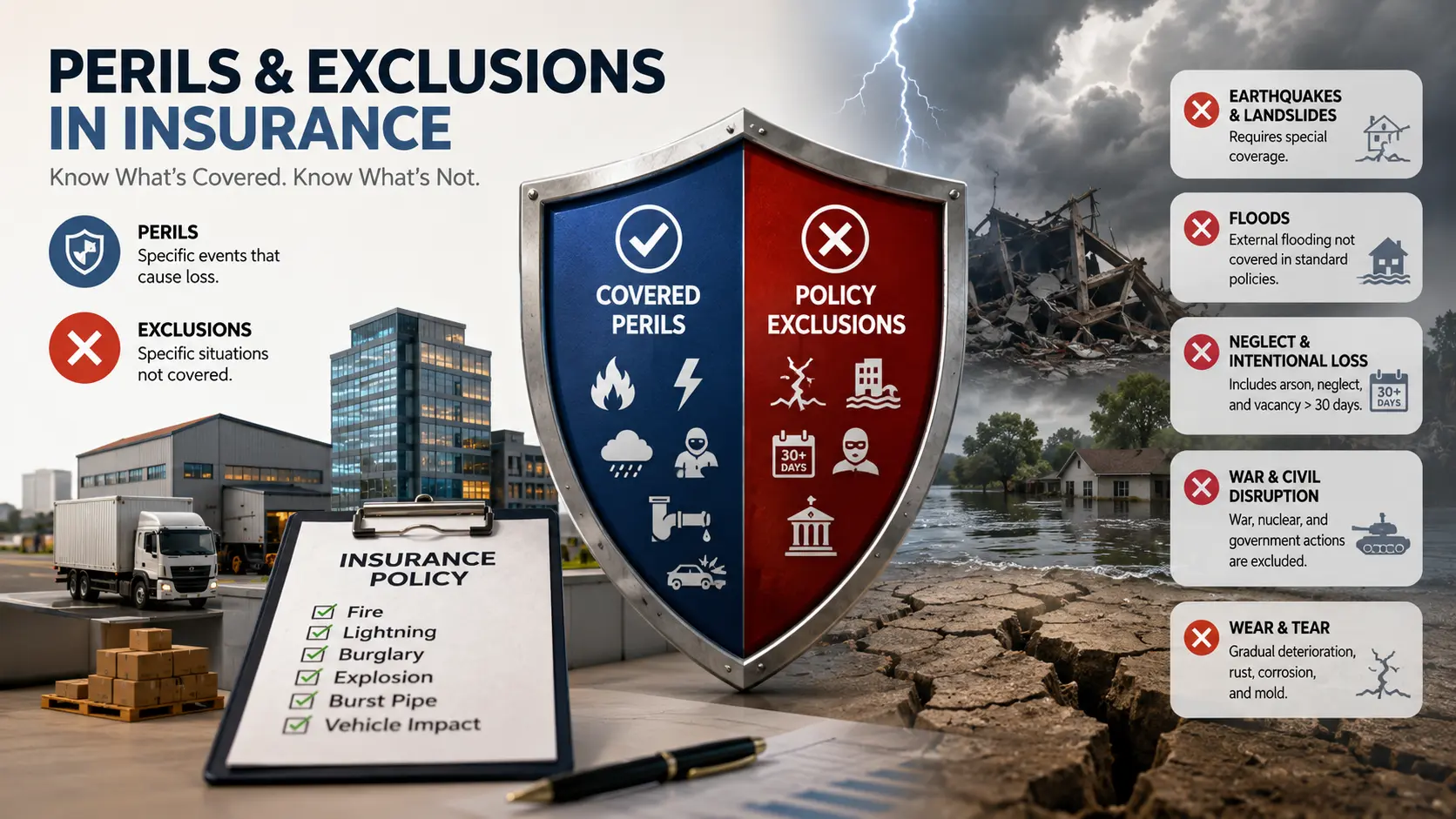
Navigating an insurance policy often feels like decoding a foreign language. Amidst the fine print, two terms dictate whether your commercial asset, retail outlet, or residential property is actually protected when disaster strikes: Perils and Exclusions.
If you run a business, manage logistics, or own property, understanding these mechanics is what prevents a catastrophic financial loss from becoming an unrecoverable out-of-pocket expense.
1. Defining the Core: What is a Peril?
In insurance terms, a peril is the specific event or immediate cause of a loss. It is the actual force that destroys an asset, halts your operations, or damages your property.
To map out how risk works structurally, it helps to distinguish a peril from its closely related counterpart, the hazard:
[ HAZARD ] ──> (Increases the likelihood of) ──> [ PERIL ] ──> (Results in) ──> [ LOSS ]
- The Hazard: A condition that increases the probability of an event occurring (e.g., faulty electrical wiring in a warehouse, or storing flammable solvents near an office kitchen).
- The Peril: The actual event that causes the damage (e.g., a Fire erupts).
- The Loss: The measurable financial damage (e.g., BDT 15,00,000 worth of ruined inventory).
Common Examples of Perils
- Natural: Lightning, cyclones, floods, earthquakes, and landslides.
- Human/Social: Theft, burglary, vandalism, riots, and strikes.
- Technical/Accidental: Explosions, burst water pipes, and vehicle impacts.
2. Policy Architectures: Named Perils vs. Open Perils
Not every policy treats perils the same way. When setting up commercial property or asset insurance, your coverage will fall under one of two distinct frameworks:
A. Named Perils Policies (The Basic Framework)
A Named Perils contract only covers losses caused by events explicitly listed in writing within the policy document. If a peril is not explicitly named, you have zero coverage.
- The Burden of Proof: If an incident occurs, you (the insured) must prove to the insurance company that the damage was directly caused by one of the listed perils.
- Example: A standard Fire and Allied Perils policy might explicitly name Fire, Lightning, and Internal Explosion. If a massive cyclone damages the roof instead, and "Storm/Cyclone" wasn't added as an endorsement, the claim will be denied.
B. Open Perils Policies / "All-Risk" Coverage
An Open Perils policy operates in reverse. It covers every single imaginable peril except for those explicitly written into the policy's exclusion list.
- The Burden of Proof: If a loss occurs, the policy assumes coverage automatically. The insurance company must prove that the damage was caused by an excluded event if they wish to deny the claim.
- Crucial Nuance: Despite the industry marketing term "All-Risk," no insurance policy covers absolutely everything. The breadth of an All-Risk policy is defined entirely by its exclusions.
3. Key Policy Exclusions You Must Know
Exclusions are the explicit boundaries of an insurance policy—the situations, events, or items where the insurer refuses to provide financial protection.
Whether you are examining a commercial fire policy, marine cargo protection, or public liability coverage, these universal exclusions heavily impact your risk profile:
I. The "Slow Damage" Category (Wear & Tear)
Insurance is designed to protect against sudden, accidental, and unforeseen events. It is not a maintenance contract.
- What is Excluded: Gradual deterioration, rust, corrosion, wet or dry rot, mold development, and damage caused by vermin or insects.
- Why: These processes happen slowly over time and are considered a predictable cost of asset ownership and preventative maintenance, rather than a sudden accident.
II. Earth Movement & Catastrophic Water
Even in comprehensive property policies, massive geographic or environmental anomalies are standard exclusions unless specifically bought back via an endorsement premium.
- Earthquakes & Landslides: Basic general property policies completely exclude seismic damage. For assets operating in high-risk zones, an explicit Earthquake & Volcanic Eruption add-on is required.
- External Flooding: While a sudden pipe burst inside your facility is typically covered, external water inundation (such as rising river levels or storm surges) is excluded from basic frameworks and requires specialized flood clauses.
III. Neglect and Intentional Material Loss
If a policyholder intentionally causes damage or fails to take basic, reasonable steps to protect an asset during or after a crisis, the policy is legally compromised.
- What is Excluded: Arson, deliberate structural destruction, or leaving an asset completely exposed to theft in an unsecured, abandoned building for more than 30 consecutive days.
IV. Government Actions, Civil Disruption, and War
High-magnitude political and geopolitical events are uninsurable under standard commercial policies due to their potential to cause systemic, widespread insolvency across the insurance sector.
- What is Excluded: Acts of war, military invasions, revolutions, nuclear hazards, or the confiscation/destruction of property by order of a public or municipal authority.
4. Perils Covered vs. Excluded: Quick Reference Matrix
| Peril Category | Typically Covered Risks (Standard Policy) | Common Strict Exclusions (Requires Add-Ons) |
|---|---|---|
| Fire & Thermal | Accidental fires, lightning strikes, smoke damage. | Spontaneous combustion, natural heating, processing heat. |
| Water & Fluid | Sudden burst pipes, accidental sprinkler leakage. | Regional river floods, tidal surges, long-term plumbing leaks. |
| Security & Social | Vandalism, physical burglary, riots/strikes (RSMD). | Internal employee embezzlement, theft during a vacancy (>30 days). |
| Geological | Falling objects, third-party vehicle impacts. | Earthquakes, sinkholes, gradual soil subsidence. |
5. Navigating "Proximate Cause" in Claims
When an asset suffers damage, the path from the incident to a successful claim payout depends entirely on the legal principle of Proximate Cause.
- The Principle of Proximate Cause: The active, efficient cause that sets in motion a train of events bringing about a loss, without the intervention of any force started and working actively from a new and independent source.
If a chain reaction occurs involving both covered and excluded perils, insurers use this strict methodology to evaluate liability:
1.Isolate the Initial Peril: Identify the First Domino. Determine the exact event that triggered the chain reaction. If an electrical short circuit (covered) sparks and causes an explosion, the short circuit is the root event.
2.Check for Intervening Forces: Trace the Unbroken Chain. Track the sequence of events. Did the initial peril directly cause the subsequent damage, or did an entirely separate, secondary event intervene?
3.Match Against Policy Exclusions: Evaluate the Core Cause. If the proximate (dominant) cause of the final damage is an explicitly excluded peril—even if a covered peril occurred along the way—the entire property claim may be denied.
Conclusion: Eliminating the Coverage Gaps
Assuming your property or commercial assets are fully covered under a generic policy label is one of the highest-risk decisions a business leader can make. Protecting your balance sheet requires knowing exactly where your policy's perils end and where its exclusions begin.
At GoodHope, we recognize that modern enterprises face dynamic, interconnected risk surfaces. We specialize in identifying hidden coverage gaps, auditing structural exposures, and crafting precise corporate risk strategies. From securing complex fixed assets against specific market hazards to providing comprehensive protection for your workforce through tailored group insurance in Bangladesh, we deliver transparent, resilient solutions designed to safeguard your commercial future.
Don't wait for a peril to expose a gap in your policy. Reach out to our corporate advisory risk team today for a comprehensive asset and coverage audit.