Blog
Construction Site Insurance Requirements: Risk Management Guide for BD
The construction boom in Bangladesh—ranging from mega infrastructure projects like expressway extensions to high-rise residential and commercial buildings—has transformed the country's urban landscape. However, a construction site is an inherently high-risk zone. From structural collapses and material theft to third-party injuries and worker accidents, a single unforeseen event can derail a project financially and legally.
Managing these vulnerabilities requires a robust understanding of Construction Site Insurance Requirements under the regulatory framework of Bangladesh. This comprehensive guide outlines the mandatory policies, essential coverages, and legal obligations required to safeguard developers, contractors, and project owners.
1. The Legal Framework: Insurance Act 2010 and Labor Law
In Bangladesh, construction insurance is dictated by a combination of the Insurance Act 2010 (regulated by the Insurance Development and Regulatory Authority - IDRA) and the Bangladesh Labour Act 2006 (amended in 2013 and 2018).
Unlike standard property insurance, construction coverage must address a fluid environment where the value of the asset grows daily, and the number of people on-site fluctuates constantly.
Public Sector Requirements
For any public project funded by the Government of Bangladesh (under the Local Government Engineering Department - LGED, Roads and Highways Department - RHD, or Bangladesh Power Development Board - BPDB), having comprehensive construction insurance is a mandatory prerequisite to winning and executing a public tender. These projects strictly enforce standard international bidding documents (like FIDIC clauses), which require specific insurance limits.
2. Core Insurance Policies for Construction Sites in BD
To properly manage risk, project owners and contractors must deploy a combination of specialized non-life insurance policies:
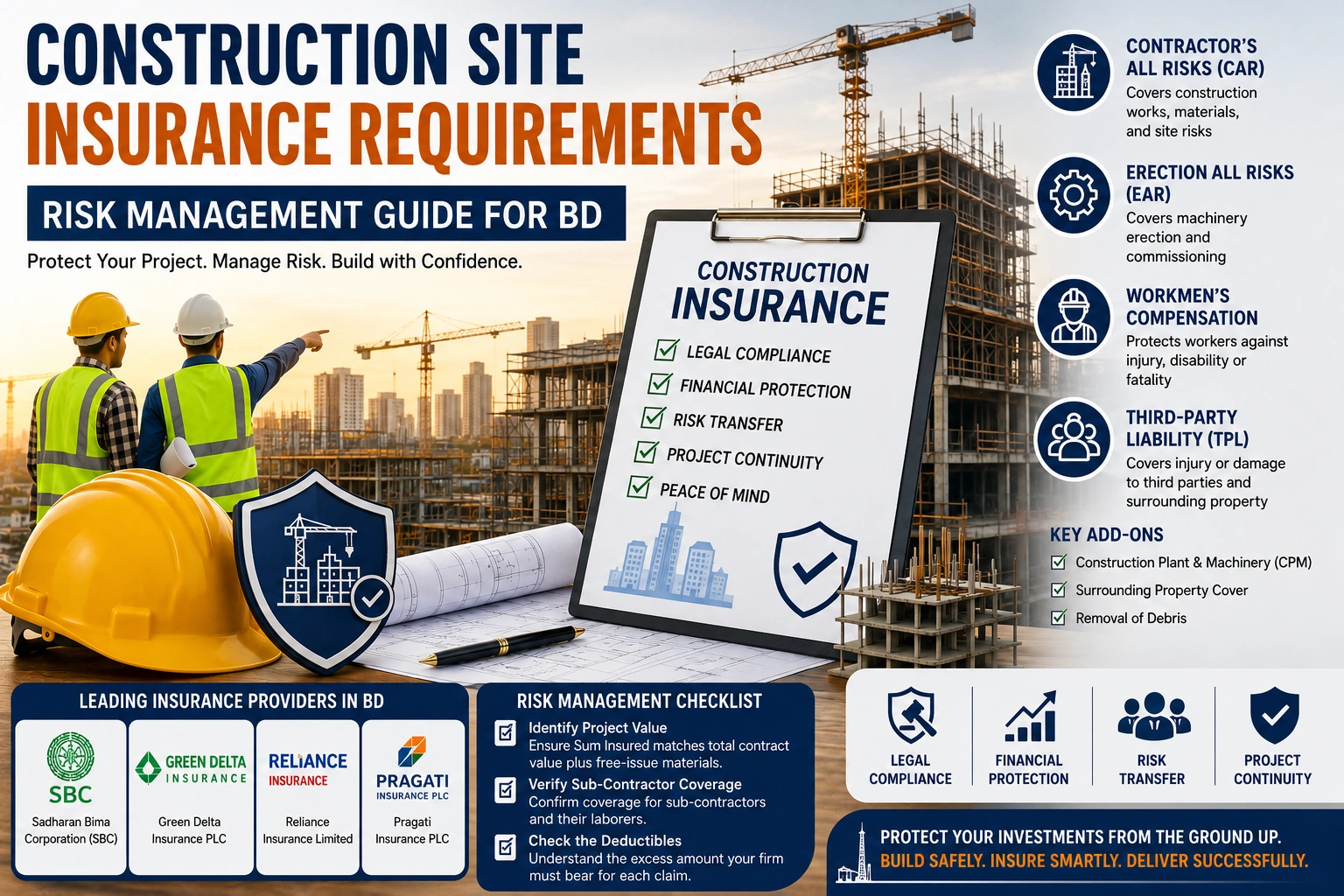
A. Contractor’s All Risks (CAR) Insurance
This is the foundational policy for any engineering or civil construction project in Bangladesh. CAR insurance provides comprehensive protection against physical loss or damage to the contract works.
- What it covers: Damage to the permanent and temporary structures during construction due to fire, lightning, flood, cyclone, earthquake, land subsidence, or human error.
- The Period: Coverage begins from the moment materials arrive at the site and typically extends until the project is handed over, including a specified Maintenance Period (usually 12 months post-completion) to cover defects discovered later.
B. Erection All Risks (EAR) Insurance
If your project involves the installation of heavy machinery, power plants, industrial factories (such as textile or RMG mills), or electrical substations rather than purely civil brick-and-mortar work, an EAR policy is required. It focuses heavily on risks during the testing and commissioning phases of mechanical equipment.
C. Workmen’s Compensation Insurance
Under Section 99 of the Bangladesh Labour Act 2006, employers are legally liable to pay compensation to workers for injuries, permanent disabilities, or fatalities resulting from accidents during work hours.
- Given the high rate of scaffolding falls and machinery accidents on local sites, a Workmen’s Compensation Policy shifts this heavy financial liability from the contractor to the insurance provider.
3. Managing Third-Party Liabilities (TPL)
A major risk that developers frequently overlook in congested cities like Dhaka and Chattogram is damage to neighboring structures and the public.
- Scenario: During deep basement piling, the soil shifts, causing cracks in the foundation of an adjacent residential building, or a construction crane accidentally drops material onto a passing vehicle.
To mitigate this, a Third-Party Liability (TPL) clause must be tightly integrated into the CAR/EAR policy. It covers:
- Legal expenses and compensation for bodily injury or death to non-workers (the public).
- Damage to surrounding properties not belonging to the project owner or contractor.
4. Key Add-Ons (Extensions) for Comprehensive Protection
A standard construction policy often excludes specific operational risks. For complete protection, developers should opt for these critical extensions:
- Construction Plant and Machinery (CPM): Standard policies cover the building but exclude the tools. A CPM extension covers expensive machinery brought to the site, such as excavators, mixers, tower cranes, and generators.
- Surrounding Property Cover: Protects the existing buildings already owned by the principal/developer within the site perimeter before construction started.
- Removal of Debris: If a structure collapses due to a cyclone or fire, clearing the massive piles of debris costs significant money. This extension pays for the clean-up operations so construction can resume quickly.
5. Major Insurance Providers for Construction Risk in BD
Because engineering insurance involves complex risk assessment and massive capital values, policies are typically underwritten by established non-life insurance companies in Bangladesh. Leading providers include:
- Sadharan Bima Corporation (SBC): As the sole state-owned non-life reinsurer, SBC directly writes or co-shares large-scale public infrastructure and mega-project risks.
- Green Delta Insurance PLC: A market leader in specialized engineering and corporate risk management, offering tailored CAR and EAR packages with digital support.
- Reliance Insurance Limited: Highly regarded for its transparent underwriting process and prompt engineering claim settlements for commercial builders.
- Pragati Insurance PLC: Frequently chosen by large-scale industrial and private developers for complex civil engineering insurance solutions.
6. Checklist: Designing Your Project’s Risk Management Strategy
Before breaking ground on your next project, ensure your risk management checklist includes the following steps:
- Identify Project Value: Ensure the Sum Insured exactly matches the total estimated contract value plus the value of free-issue materials supplied by the owner.
- Verify Sub-Contractor Coverage: Clearly establish whether the main CAR policy covers sub-contractors and their laborers, or if they must carry separate individual insurance.
- Check the Deductibles: Understand the "Excess" or deductible amount your firm must bear out-of-pocket for each engineering or material loss claim.
Conclusion
Construction site insurance is not merely a bureaucratic requirement to satisfy a bank loan or a government tender; it is a vital pillar of financial risk management. By deploying the correct mix of Contractor's All Risks and Workmen's Compensation coverage, developers can protect their capital investment and ensure their projects reach completion without devastating legal or financial interruptions.
At GoodHope, we are dedicated to simplifying the insurance landscape for businesses and individuals alike. Whether you are seeking automated corporate solutions like group insurance in Bangladesh for your workforce or looking to protect your transport fleet with specialized commercial coverage, our digital platform makes managing risk transparent and convenient.
Protect your investments from the ground up. Explore our smart digital insurance solutions today.