
Blog
The Concept of Deductible in Insurance: How It Works in Bangladesh
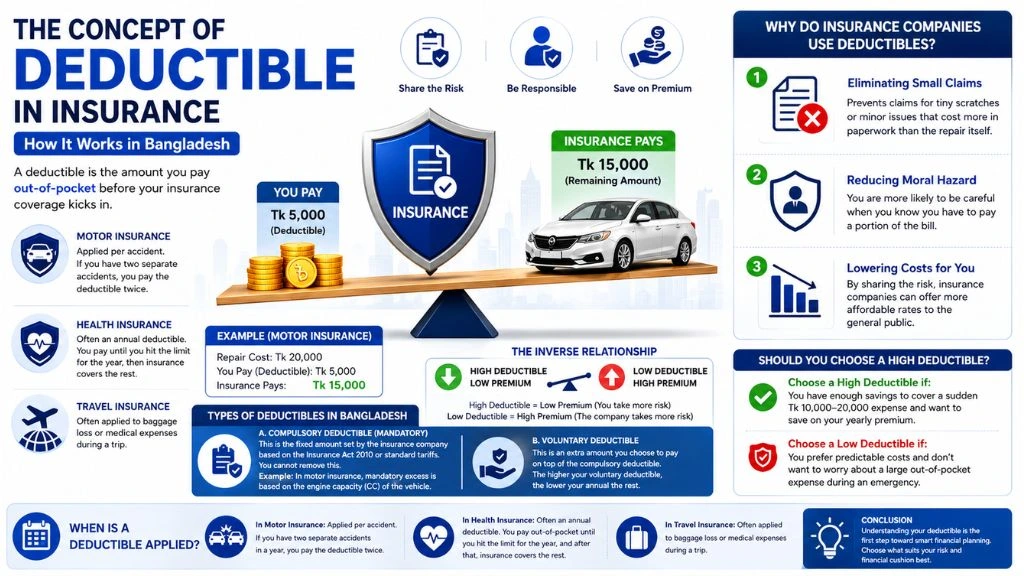
In the insurance world, a deductible is a crucial term that directly affects how much you pay for your policy and how much you receive during a claim. While it is common in international markets, it is increasingly being integrated into various insurance products in Bangladesh, especially in motor and health insurance.
Essentially, a deductible is the "out-of-pocket" amount you agree to pay toward a loss before the insurance company steps in to cover the rest.
1. How a Deductible Works
Think of a deductible as a way of sharing the risk between you and the insurance company. When you file a claim, the deductible amount is "deducted" from your total claim payout.
Example:
Imagine you have a car insurance policy with a Tk 5,000 deductible. You get into a minor accident, and the repair cost is Tk 20,000.
- You pay: The first Tk 5,000.
- Insurance pays: The remaining Tk 15,000.
2. Types of Deductibles in the Bangladesh Market
In Bangladesh, deductibles (often referred to as "Excess" in motor insurance) generally fall into two categories:
A. Compulsory Deductible (Mandatory)
This is the fixed amount set by the insurance company based on the Insurance Act 2010 or standard tariffs. You cannot remove this. For example, in motor insurance, there is often a mandatory excess based on the engine capacity (CC) of the vehicle.
B. Voluntary Deductible
This is an extra amount you choose to pay on top of the compulsory deductible.
- The Rule: The higher your voluntary deductible, the lower your annual insurance premium will be. It is a great way to save money if you are a safe driver or a healthy individual who rarely makes claims.
3. The Inverse Relationship: Deductible vs. Premium
There is a direct "see-saw" relationship between your deductible and your premium:
- High Deductible = Low Premium: You take more risk, so the company rewards you with a cheaper policy.
- Low Deductible = High Premium: The company takes more risk, so you pay more every month or year.
4. Why Do Insurance Companies Use Deductibles?
You might wonder why insurance companies don't just cover everything from the first Taka. There are three main reasons:
- Eliminating Small Claims: It prevents people from filing claims for tiny scratches or minor issues that cost more in paperwork than the repair itself.
- Reducing Moral Hazard: When you know you have to pay a portion of the bill, you are more likely to be careful with your property or health.
- Lowering Costs for You: By sharing the risk, the insurance provider can offer more affordable rates to the general public.
5. When is a Deductible Applied?
- In Motor Insurance: It is applied per accident. If you have two separate accidents in a year, you pay the deductible twice.
- In Health Insurance: It is often an annual deductible. You pay out-of-pocket until you hit the limit for the year, and after that, the insurance covers health insurance expenses for the rest of the year.
- In Travel Insurance: Often applied to baggage loss or medical expenses during a trip.
Conclusion: Should You Choose a High Deductible?
Choosing a deductible depends on your financial "cushion."
- Choose a High Deductible if: You have enough savings to cover a sudden Tk 10,000–20,000 expense and want to save on your yearly premium.
- Choose a Low Deductible if: You prefer predictable costs and don't want to worry about a large out-of-pocket expense during an emergency.
At GoodHope, we aim to make these complex terms easy for you. Whether you are managing risks for your truck or looking for the best travel insurance for your next trip, understanding your deductible is the first step toward smart financial planning.